
Does first love last forever?
Trying to understand why memories of teenage love can love linger in adulthood

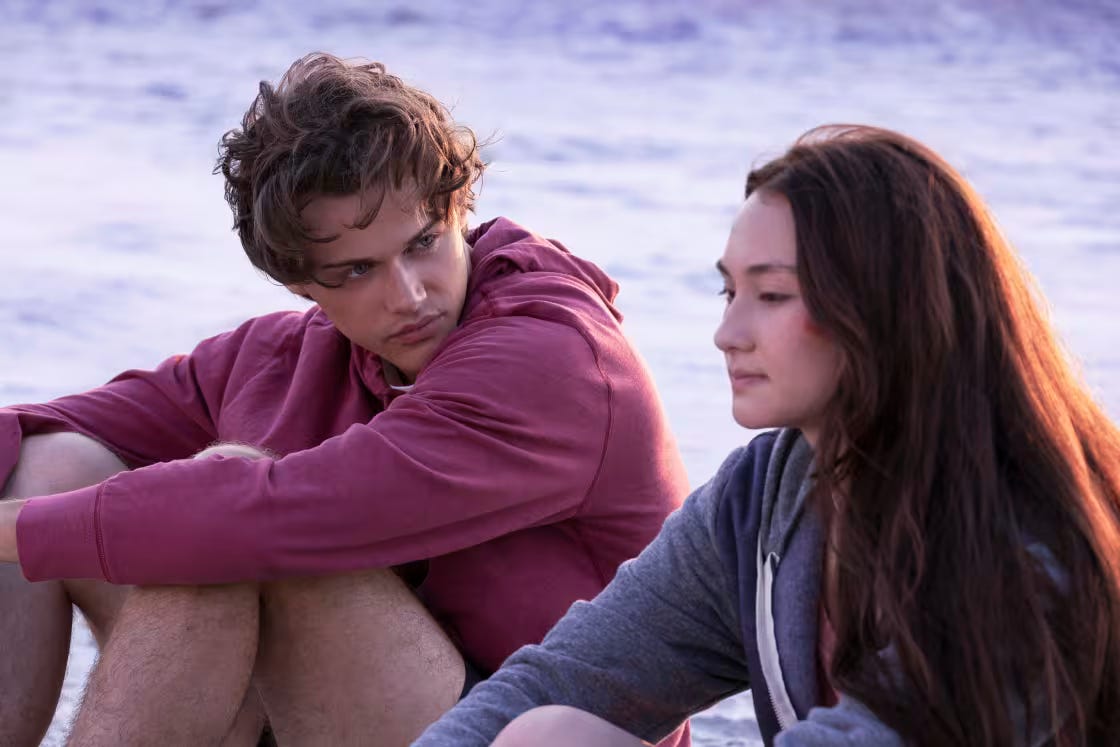
Conrad and Belly in The Summer I Turned Pretty / Amazon Prime Video
My teenage boyfriend still appears in my dreams sometimes. Not often, but once a year or so. Each time it confuses the narrative of the dream. Like there’s an extra who starts saying the main character’s lines even though they never got the part.
It feels oddly vulnerable to write that fact, even though I’m happily married and have a friendly-from-a-distance relationship with my first love (because he is a family friend). There is no present drama, no residue of real romantic feelings. So why the guest appearances in my subconscious? And why can I still see the scenes from our youth in a collection of details stored somewhere forever? A grazed knee, a Carhartt belt, a light sabre fight with curtain poles.
Partly it’s the writer in me; a will-they-won’t-they narrative over the course of 16 years is a good story. It’s also the first one I ever wrote, the first reason I started writing, on torn out pages of my mum’s notepads, in poems stored in a shoebox under my teenage bed, now under my adult bed. Every failed novel I wrote as a teenager - the horny Lord of the Rings rip off, the excruciatingly earnest YA romance - was a badly disguised version of our relationship(s). Of course I remember the details; I wrote a lot of them in biro.
But it’s not really about the specific subject matter anymore, or even the person. I wonder if remembering past details is a way of insisting, that version of me is still in here. I might look old and tired. My hair might be 66% grey. I might be a cliche of motherhood who says “PUT ON YOUR SHOES” 18 times a morning. All this and still, one night I look down at my daughter’s legs wrapped up in mine on the bed, and just for a second, I’m shocked to see that mine are the older ones.
Perhaps youth feels more present because I relive my childhood as I parent. I hear my dad’s voice in mine as I say, “You need to tidy your toys off the floor so I can at least hoover the carpet!” and I remember the precise pain of a stinging nettle as I press a doc leaf against my daughter’s leg when she gets stung. As I get older, the younger me feels closer to the surface, not further away. Maybe I revisit past details of her longings because I am scared of forgetting her and want her to live forever. Maybe that’s why I source a book I borrowed from the school library aged 12 and start reading it again at 41; I want the younger version of me to somehow be acknowledged or expressed.
But really, I don’t know, and that led me to today’s interview.
Like many people, I’m obsessed with stories of adolescent love. Dawson’s Creek and Call Me By Your Name and The Summer I Turned Pretty and Normal People. Forget battles and odysseys; there is something epic about time passing and people connecting through all the layers of their present and past in one moment, in one knowing look.
Today’s guest, psychologist and writer Lucy Foulkes, thinks we love stories like these because society dismisses teenage love as unimportant. She wrote in the Guardian, “It is as though we give ourselves permission to acknowledge the power of adolescent love in stories, but cannot acknowledge it publicly about ourselves.”
Below, Lucy gives me - and hopefully any of you with similar feelings - that permission. Her answers show why adolescent love often lingers in adulthood, and why it might still be important, even if it mainly existed in your head.
***

Psychologist and writer Lucy Foulkes specialises in adolescence
Natasha: Why do you think first love becomes so imprinted in our memories?
Lucy: In adolescence, you’re more exposed by the fact that it’s the first time. You’re more naive; you’re more vulnerable; you’re willing to admire someone and put them on a pedestal. You haven’t yet learnt coping skills or reasons to be more skeptical. You’re also trying to figure out your identity and, if you enter into a romantic relationship, that’s one of the first times you see yourself reflected back at you. So when you’re rejected, it’s more of a dent on your understanding of yourself and your nascent, fragile identity.
You also really care about what other people think about you. It’s extra wonderful when someone is attracted to you and extra awful if it goes wrong. If the equivalent happened at 35, firstly, you already have a pretty established sense of self so it’s not going to have such a strong impact on your identity. You’ve also got a bank experience to draw on to help you realise it’s not necessarily just about you. Or that you’ve gone through something similar before and you’ll be able to get through it again. You don’t have that in adolescence. And when you are more malleable and unstable, events become absorbed into your identity and how you understand yourself.
All of this applies more if something ambiguous happens, or it goes wrong. It’s perfectly possible to have good relationships in adolescence that you’re not still dreaming about as an adult. It depends on what happened and how the relationship ended.
NL: In my experience as a teenager, it wasn’t that there was necessarily a long-term relationship involving daily contact. The relationship existed more in the in-between periods when we weren’t together. How do you think ambiguity like that intensifies things?
LF: “Situationships” or “imaginationships” can be problematic because you idealise someone; the version of the relationship in your head is perfect and amazing, so it feels a more painful thing to not have. And often those relationships don’t end in a satisfying or logical way. If it ended and you didn’t want it to, you’re grieving the loss of a future that you wanted to have together. But even if the ending isn’t what you wanted, if it’s clear, and it makes sense, you feel closure. The trouble with imaginationships, or relationships that end with ghosting, is the lack of conclusion means you keep going over and over it. You can’t close the lid on it in your brain. It’s very easy to romanticize that uncertainty, and to misunderstand it.
NL: Why do you think those feelings can linger so powerfully beyond adolescence?
LF: The romantic relationships you have as a teenager become the foundations on which everything else is built. It’s like when you’re reading about a character in a novel, the things that happen to them in the early chapters inevitably shape who you think they are later on. Similarly, if you’re rejected in adolescence and that’s the first time you’ve ever experienced love, you’re going to think that’s more a part of you, or because of you, than if it happened when you’re 30.
NL: I’m always amazed by how clearly I can recall tiny details about my early relationships. Could you tell me more about the “reminiscence bump”- why our brains are better at capturing details in adolescence?
LF: No one really knows for sure. The boring explanation is that because our brains are younger and more optimally functioning, they’re better at encoding memories clearly. So if you have a 20-year-old’s brain relative to a 90-year-old’s brain, it’s going to be better at absorbing information into long-term memory stores. The other explanation is it’s the first time things happen: experiences are newer, they’re more remarkable, so they are stored in your brain more powerfully. When anything is new you’re better at paying attention to it; once something has happened a few times it’s harder to notice every detail. Just like I remember the first time I drove my car on my own in detail, but it’s harder to remember the details of any other unremarkable car journey. When you’re out in the world properly for the first time, there’s more scope for interesting things to happen.
I’m also very interested in this idea that adolescence is the first time you have the mental ability to reflect on who you are and what happens to you. That’s the first draft of the story you tell yourself about who you are. It doesn’t have to be fixed; you can rewrite the story. But that first draft will always exist in your mind somewhere.
NL: Maybe that’s why I and so many others are obsessed with younger shows like The Summer I Turned Pretty, because we don’t feel our teenage relationships and those first drafts are taken seriously, and those shows are an outlet for those feelings?
LF: Definitely. We’re allowed to acknowledge the power of these relationships in fiction and that’s part of their appeal. People accept stories like Normal People as a great love story, but we don’t get the permission to take them as seriously in our own lives.
NL: Do you think it’s significant that in adolescence you’re not always in control of your own time or when you might get to see somebody? Because you might be reliant on a parent to take you there, or you might not have the money. Is there something about that lack of agency that intensifies the feeling?
LF: It creates more longing when you’re restricted by your families, definitely. You can’t be alone with the person you love in the way that you yearn to be. Obstacles like these create drama and longing that is partially unpleasant, but not entirely so. Actually, if you were both available, you might hang out together all the time and it might not last. But you might not get to that point when you’re young.
There’s just so much potential in a brief relationship - you weren’t together long enough to actually realise why you weren’t compatible. So you can create the fantasy of who a person is and what you could have been.
NL: The first two years of a child’s life are given a lot of importance. Do you think perhaps we should pay more respect to how adolescence shapes our attachment, as well as childhood?
LF: Yes. There’s something very specific in adolescence in terms of how you feel about yourself and social relationships, and how this then affects you as an adult. So whether you trust your friends, whether you think they like you, how confident you feel walking into a room, how confident you are in romantic relationships, how you feel about yourself, and how you think other people relate and respond to you. Those things are formed in adolescence and if you have a bad time, you see the traces of them for many years later in relationships.
NL: I loved the 2003 study you shared in your Guardian article, in which adults were asked to recall when in life they had felt strong emotions. People in their 20s reported being the most in love right now, but for all other age groups, the peak was at age 15.
LF: That was so validating. Before, I’d not really allowed myself to acknowledge that my early heartbreak was a difficult thing to have gone through, or that it was understandable that I still thought about it many years later. Writing about it gave me permission to take my own experience seriously and made me realise it wasn’t just me. So that’s what I learnt: just because a teenage relationship is historical, or it largely exists in the mind, it doesn’t mean it’s not real or important.
NL: But also maybe the fact that just because it feels important, that’s not necessarily a sign that you have feelings for them in the present. It might be more about your own identity, or maybe a desire to feel connected to your youth?
LF: Yes, or sometimes the feelings that linger are more about the fact that a relationship was ambiguous or unresolved, rather than the person you once loved. Often in ambiguous situations, people mistake the intensity of the feeling for evidence of their feelings, when actually it’s just evidence that the relationship didn’t make sense.
NL: Something I’ve been thinking about is, as you grow older and have more responsibilities, you want to keep memories of your youth alive. You don’t want to feel just like a caregiver, or someone who takes out the bins, but like the younger yearning, dreaming, intense part of yourself too. That’s something I access through music, but I wonder if that’s why we can be drawn to old friends who knew us when we were younger too. I guess I feel as I age that a younger part of me is closer to the surface, not further away. Do you feel that?
LF: Definitely. And that’s why it’s interesting that Esther Perel says affairs aren’t necessarily a crisis in the relationship, but a crisis of the self; a desire to get back some part of you that you feel has gone missing in your current life. Romantic relationships in general are about that; that’s part of their appeal. It’s about being a version of yourself that you like - or that another person is interested in - and that it is appealing to you to be seen in that way. It's the same idea as enjoying music from our adolescence, or seeking out the friends we had at the time - it's partly about remembering or restoring a version of ourselves that we liked.
NL: You said that when your friend asked if you’d mind if they invited your ex to a wedding you were attending, you cried. But when you saw him at the wedding it was a peaceful conclusion. How have your feelings about that early relationship changed?
LF: It was healing, because it was almost like something in my brain got fixed by seeing that the 17-year-old version of him didn’t exist anymore. He was polite and nice enough. I wondered whether there would be any acknowledgement of our breakup, but there wasn’t, and I think that confirmed that it didn’t remotely have the same significance for him as it did for me. Acknowledging that and seeing him as a real-life person, it brought the story to an end. It was an open box for 15 years, and then I could finally close it.
Writing about it was part of that too. Because the act of writing requires you to consider the other person’s perspective, and often in adolescence you can get stuck in your own imagined perspective.
NL: What’s the most significant thing you’ve learned about first love?
That it’s real, and powerful. It’s not a light, funny version of a real phenomena. It’s serious and wonderful and awful, in the same way that adult love can be. We should respect it a lot more.
***
Things I love
Whether you want to understand your teenager or your teenage self, this exploration of adolescence treats an important moment in life with tenderness.
One way I express the younger version of myself now is through music. I’ve written about this process this week - and why I think I am in midlife girlhood - in a piece on the new Olivia Rodrigo album for the All Bright. You can read it here.
Her writing is similar to her music: arms flung out wide, come on in, life is fun and joy is possible. It’s a treat to get a look inside her writing process and how she feels when working on a new album. (Also I’ve been relistening to Back in My Body since Off Campus. goditssogood)
The Invite
Olivia Wilde said audiences were split on the ending of this film: half of viewers felt it was a cynical view of long-term relationships, half thought it was sentimental. I was in the latter camp. More importantly: laughed lots.
The Big Picture
The only podcast I’ve stayed loyal to over the last four years. Amanda and Sean talk about new film releases, do fun drafts where they pick films from particular years and look back at actor’s filmographies. They always give me a heads up on great new films (they were the reason I messaged Lewes Depot cinema asking for them to show The Invite!). They also had a good interview with Olivia Wilde recently.
Rosalia’s Lux tour (and album)
The joint best gig I’ve ever been to (tied with eras tour). It was like a ballet and a rave and an opera and a musical and a visit to church. Another reminder that finding a way to go to gigs is never a waste of time or money. (Laura Snapes did a great post on it.)
Pretty sure I’ve put Frankie’s newsletter in my picks before, but adding it again because I asked for these denim shorts she recommended for my birthday and I have been living in them since. I’ve never worn shorts much because I’m short and pear-shaped and I couldn’t find a pair that looked good. But Frankie found me a pair that I feel good in! I’ve had three compliments since wearing them. That’s her skill.
If you’re ever in Lewes, go support this cinema. (Also come say hi to me!) Or just let this be a reminder to book tickets to your local cinema. If love is connection to strangers, then sitting in a dark room with people and all feeling something is a form of it too. I made a resolution to go more this year and have been at least once a month. My life is so much better for it.
Being back in your inboxes
Now that I am a wedding-celebrant-in-training (!) I’ll be able to write this Substack more often. I paused paid subscriptions while I didn’t have time to, but will be turning them on again for the next post (the first-person ones will be behind a paywall). As ever, requests and suggestions welcome. And if you’d like me to officiate your wedding… stay tuned!
With love,
Natasha
Omg Natasha! I am so glad you wrote this piece. I dream about old boyfriends and have thoughts about people from the past who I had feelings for from teenage years. I started to beat myself up about this as I am with a loving partner and started to wonder if there was a deeper reason why I was doing this. Turns out… there’s not. This has given me so much insight. Teenage years, friendships and first love are so intense and all encompassing. I often think back a lot to friendships too.
Loved, loved, loved reading this! (And I also loved your book too ❤️) thank you! X
I wonder too if it's about how wide-open everything was, that at that moment you can be anything, so love at that point feels like there's nothing restricting your ability to become who you want to be. And love (to me) it always at least partly about becoming that desired self through the relationship. The first time it feels more possible than any other.